In recent years, the poultry and pig industry has been successfully developing reduced crude protein (CP) diets by supplementing unbound crystalline L-Lysine, L-Methionine, L-Threonine, L-tryptophan, L-Valine, L-Isoleucine and L-Arginine.
In broiler chicken diets, soybean meal is the major protein ingredient and it contains 46-48% CP but extremely deficient in Methionine. Therefore, if we only use soybean meal to meet chicken methionine requirement, the dietary CP level may reach 30% and other animal acids will become surplus and need to be excreted by using extra energy cost.
Obviously, this will increase feed cost and result in nitrogen pollution as well.
However, if we add crystalline L-Methionine to this chicken diet, the dietary CP level can be dropped to about 25% by reducing soybean meal inclusion levels and thus, in poultry diets, L-Methionine is considered to be the first limiting amino acid. Similarly, by adding L-Lysine, L-Threonine, L-Valine, L-Isoleucine and L-Arginine to poultry diets, the dietary CP levels can be further reduced and these 5 amino acids are considered as the second, third, fourth and fifth limiting amino acids, respectively.
In pig diets, L-Lysine, L-Threonine, L-Methionine, L-tryptophan, L-valine, L-Isoleucine and L-arginine are the first, second, third, fourth, fifth, sixth and seventh limiting amino acids, respectively.
CP reduction: 3.93% or 1.39% in maize or wheat-based diets, respectively.
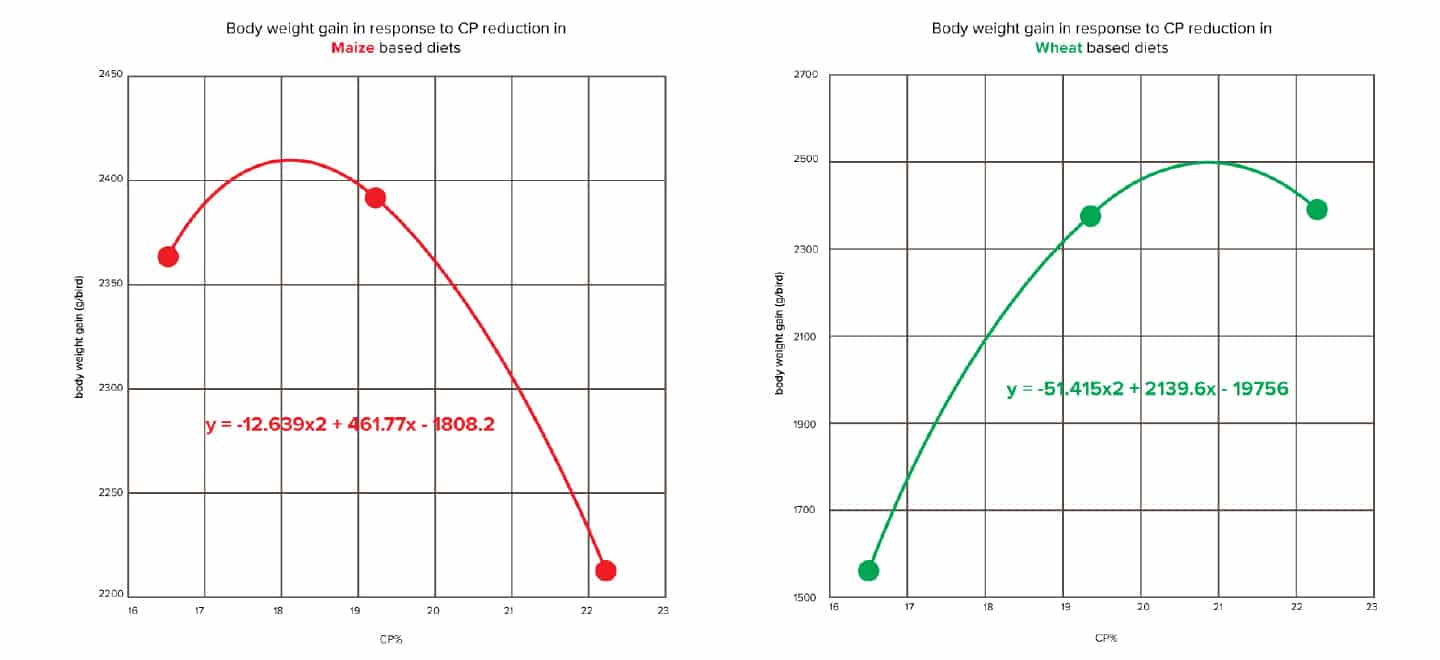
In Australia, each year about 600 million broiler chickens will produce more than 500 million kg of litter. When reducing each 1% dietary CP units can result in nitrogen reduction by about 40,000 MT. Apart from this environmental advantage, reduced CP diets have the potential to enhance litter quality, lower incidences of foot-pad dermatitis and improve flock health by reducing potential pathogens infection including Clostridium perfringens.
It is noteworthy that reduced CP diets may result in amino acids redistribution away from growth and production processes, towards essential functions, such as maintaining the intestinal cells involved in immune and inflammatory responses. Thus, a dietary ideal amino acids balance profile is crucial for reduced CP diets.
Recently we have recommended a full amino acids profile including non-essential amino acids. In this profile, the optimal ratio of essential to non-essential amino acids ratio is kept as 0.46.
In addition, reductions in dietary CP levels are usually achieved by increasing feed grains inclusions at the expense of soybean meal, relatively increasing carbohydrates levels as the energy source. Because soybean meal contains a much higher choline concentration than feed grains, in reduced CP diets for chickens, it is necessary to supplement extra choline chloride and in reduced CP diets for pigs, more betaine needs to be added. Relatively higher carbohydrates may also result in fatty carcass, lower plasma high-density lipid (HDL) and fatty liver disease and therefore, the energy from fat or oil is necessary to maximize chicken or pig performance in this reduced CP diets.
If you’d like to know more, please contact one of our industry specialists today.